Collaborative robots
The collaborative robot built for industrial speed
Most cobots sacrifice speed for safety. PoWa™ doesn't.
With performance exceeding 5 m/s at rated payload, ABB's PoWa is the fastest collaborative robot family in its class — designed for machine tending, palletizing, material handling, and welding in real industrial environments.
From Unboxing to Production in 60 Minutes
PoWa is designed for operators, not integrators. No specialist programming knowledge required.
Easy to program
Easy programming and arm-side programmable buttons designed for operators on the floor.
Plug and play integration
Plug and play integration support so you can connect your tools without custom wiring or added system complexity.
No-code reconfiguration
Operators can reconfigure directly on the floor using arm-side buttons and no-code Wizard programming.
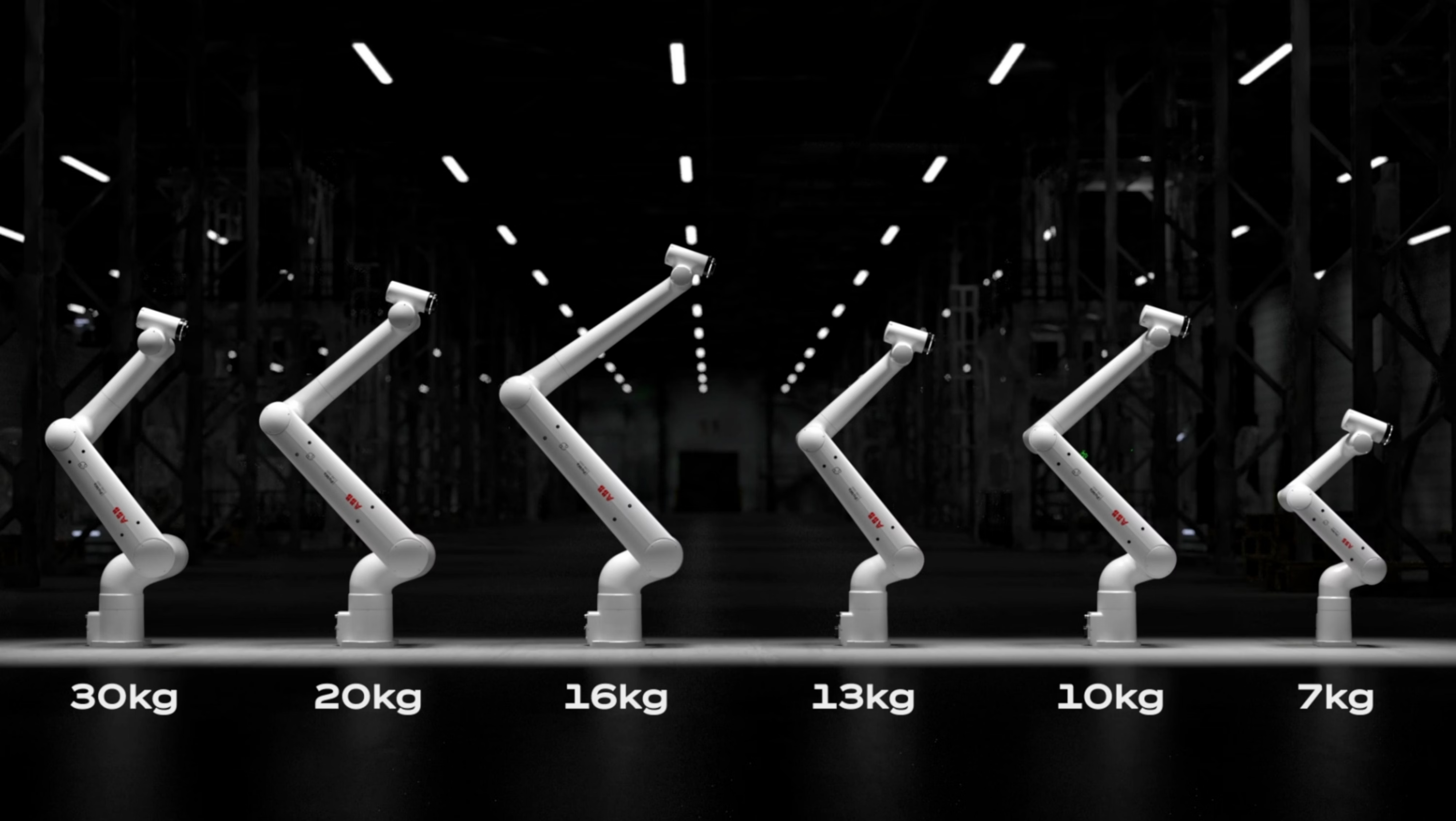
Meet the high-speed powerful cobot family
Step into the new era of collaborative automation with the official launch of PoWa™, ABB Robotics’ powerful family of cobots. In this exclusive digital event, discover how PoWa™ is redefining industrial automation by combining high speed, higher payloads, and collaborative flexibility in one powerful solution.
Available Variants
Reach and payload specifications across all PoWa series models.
See what PoWa™ can do for your production line
Talk to an ABB robotics engineer about your specific application — machine tending, palletizing, welding, or material handling.
FAQS
There are three types of collaboration, coexistence, intermittent collaboration and cooperative or close collaboration. They are enabled by safety-rated safety functions in collaborative robots, including power and force limiting, speed and separation monitoring, hand guiding, and safety-rated stop, as defined by ISO10218-1 and ISO/TS15066.
Collaborative robots are useful where flexible automation is needed, such as smaller production batches where a lot of manual labor exists today. Collaborative robots have a smaller footprint with a lightweight design which makes them suitable for environments with limited spaces, their easy programming and lead-through features makes them ideal for first time robot users. The collaborative robots are ideal for customers who want to create a barrier free work environment where humans and robots can work side by side.
The process is very similar to a standard risk assessment for an industrial robot application, you should follow ISO10218-2 and also ISO/TS15066 as guidelines. You can also search on the internet for risk assessment templates and resources.
Please follow a standard risk assessment before designing your application. Assess the risk factors associated with human robot collision, gripper, fingers, layout of the application & equipment around the application.
SafeMove can be used to monitor the speed and position of Single Arm YuMi® so that any unwanted human robot collision can be prevented.
Customers should ensure that the design of the Gripper, fingers and fixtures is smooth without any sharp edges. You need to consider all potential collision and clamping situations. It is also important to consider the additional hazards brought in by other tools or machines in the application environment. Always do a safety risk assessment of your collaborative robot application!
Generally, yes. For every modification in a pre-existing application is necessary to review the related risk assessment that is the key document in the certification process. If the new application brings new and different hazard these need to be reconsidered.
Some typical measures to reduce this risk are to program the arm to move with the elbow pointing down, and the same for the gripper. Another measure can be mounting the robot in a position where it’s not possible to have contact with a human face. For Single Arm YuMi® with the SafeMove option it is possible to define virtual zones for the robot movement. We also always suggest the use of safety goggles to protect the eyes. In some application it may make most sense to use physical barriers such as a plexiglass screen.
Safemove provide safety-certified safety functions that monitor the robot’s behavior with a PL d-certified reliability. However, in order for the robot to react to human presence it needs external sensors to notify it of the location and presence of humans, hence the need for external safety sensors.
The relevant international standards for collaborative robots are: